
Disclaimer: This list of relevant terms aims to provide a simple explanation of typical words and phrases used in the consideration of sustainability criteria and life cycle assessments of alternative marine fuels, as agreed by members of the Global Industry Alliance to Support Low Carbon Shipping (Low Carbon GIA). However, no representation or warranty, express or implied, is made as to its accuracy or completeness. It is a non-exhaustive list and the terms as explained are in no way to be considered “agreed definitions” from an IMO perspective, and do not imply the expression of any opinion whatsoever on the part of the IMO. For definitions, refer to ISO 14040/44 as appropriate.
The figure below has been modified from ISO 14040.
This is a standardised framework (set out in ISO 14040/44) that allows compilation and evaluation of the inputs, outputs, and the potential environmental impacts of a product system throughout its life cycle. LCA is based on four main phases:
The system boundary determines which entities (unit processes) are inside the system and which are outside by demarcating the boundaries between the studied product system and the surrounding economy and the environment. It essentially determines which life cycle/supply chain stages and processes are included in the assessment. The system boundaries need to be in accordance with the goal and scope of the study.
The broader the system boundary, the more processes that directly and indirectly contribute to the system will be considered. For example, in a “cradle-to-grave” study, the system boundaries include all the processes from the extraction of all the raw resources to the intended point of use of the delivered product and its disposal, while in a “cradle-to-gate” study, the system boundaries end at the gate of the factory where the studied product is produced.
This is a phase of the Life Cycle Assessment study. The LCI analysis involves the collection, compilation, and quantification of all inputs (resources, materials, semi-products and products) and outputs (emissions, waste and valuable products) for the product system under study.
The functional unit (FU) provides a reference to which the input and output flows from the LCI are normalized. The functional unit defines and quantifies the aspects of the reference product’s function by generally answering the questions “what?”, “how much?”, “for how long/how many times?”, “where” and “how well?”.
For example, the functional unit for fuels could be ‘1 MJ of delivered energy’, and hence the output flow for emissions related to global warming potential could be scaled to the functional unit and expressed in gCO2e/MJ.
Processes in the product system that deliver more than one output or service of which not all are used by the reference flow of the study. Multifunctional processes are a challenge in LCA. In order to solve multifunctionality issues, the ISO standard presents a hierarchy of solutions, which should be applied in the following order:
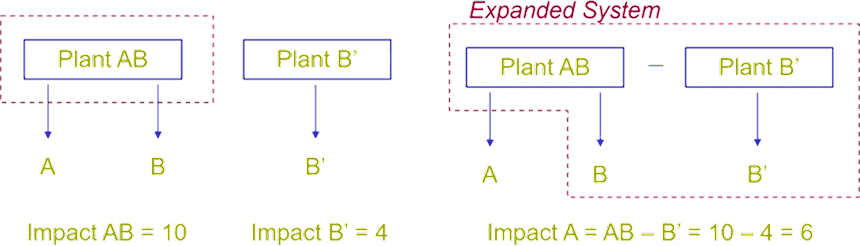
System expansion is another approach to solve multifunctional processes.
System expansion enables the comparison of two systems by adding another not provided function or subtracting not required function(s) substituting them with the ones that are superseded or replaced. For example, for a comparison of two processes, system expansion means expanding the second process with the most likely alternative way of providing the secondary function of the first process (see example below).
Allocation is another approach to solve multifunctional processes, and distribute environmental impacts (e.g., emissions) between two or more products resulting from a process or product system.
Allocation can be done by mass, energy, and economic value of the resulting products. Essentially, this method focuses on the individual product unit, which is assigned a share of the overall environmental impact, rather than considering the system as a whole. The inputs and outputs of the system are partitioned between its different products or functions in a way that reflects the underlying physical (or economical) relationships between them.
For example, consider a process (Process AB) which produces Product A and Product B, with a ratio of 1:4, in terms of energy used. The impact of Process AB is 10. Applying allocation, the share of impact allocated of Product A would be 2, and the one of Product B would be 8.
The Life Cycle Impact Assessment (LCIA) phase translates the physical flows and interventions of the product system defined in the life cycle inventory, into impacts (environmental impact scores) on the environment using LCIA methods based on environmental science.
As per ISO 14040, the impact category is the class representing environmental issues of concern to which life cycle inventory analysis results may be assigned. In other words, an impact category combines multiple factors that cause the same impact on the environment into a single environmental effect.
For example, carbon dioxide (CO2), methane (CH4) and nitrous oxide (N2O) among others lead to the greenhouse effect and can be converted into a single unit (e.g., kg CO2e) that translates into one impact category (e.g., climate change).
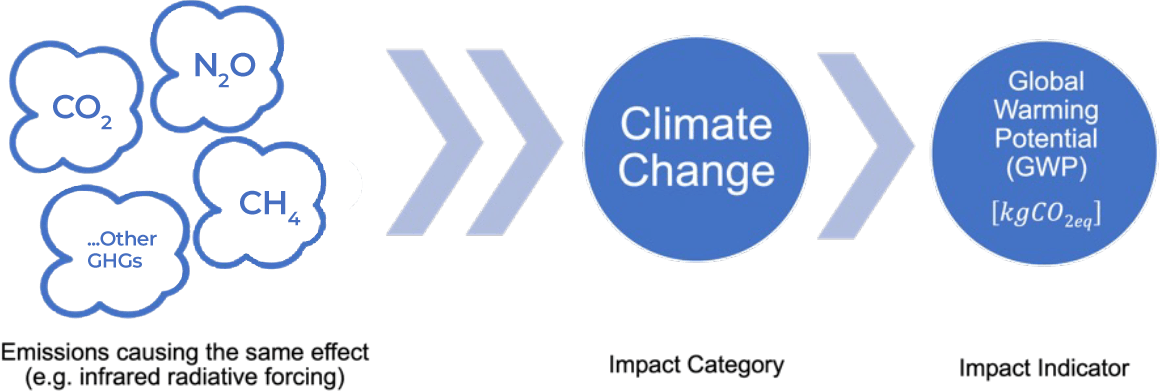
As per ISO 14040, the impact indicator is a quantifiable representation of an impact category. It may also be known as an “impact metric” or “impact category indicator”.
For example, for climate change (an impact category), the related impact indicator (global warming potential) is expressed in kg CO2e.
Examples of impact indicators can be found in the tables below.
Sustainability criteria are parameters for the production processes (including extraction and cultivation) and quality of those processes that must be met to obtain a sustainability status or certification. Often sustainability criteria will consist of multiple impact categories against which a product lifecycle impacts will be assessed.