

This portal aims to provide an overview of the concept of Just in Time (JIT), the main benefits, and general steps which can be taken towards its implementation.
The portal brings together useful resources, including those both developed internally under Ship-Port Interface Workstream of the Global Industry Alliance to Support Low Carbon Shipping (Low Carbon GIA), and those developed by other international organizations, all with a view to further support the implementation of the JIT concept.
The process of making a port call nowadays is generally not optimized. Ships may “hurry” to the next port, only to find out that the berth is not available because another ship is alongside, cargo is not available for loading, or no tank is available for discharging, for example. This results in a ship either having to “wait” outside the port at anchorage for many hours, days or even weeks, or manoeuvre at very low speeds in the port area while waiting for the availability of berth, fairway and nautical services. This “hurry up and wait” mode of ship operation has many disadvantages and from a safety, environmental and economic perspective can be improved significantly.

The term ‘Just in Time’ is used to describe a ship that has sailed to a port with the least amount of bunker fuel consumed, but still arriving in time. In doing this, a ship will save fuel, GHG emissions and will also reduce its anchor time at ports. These factors will have a positive impact on safety, environment and efficiency.

According to EMSA’s report 2021 “Annual Overview of marine casualties and incidents”, most accidents happen during or just before a port call. When sailing JIT, there is a reduced number of ships close to ports, and as a result, increased navigational safety in port approaches and anchorages. Communication and clarity prevent last minute manoeuvres and increase the safety of the port call.
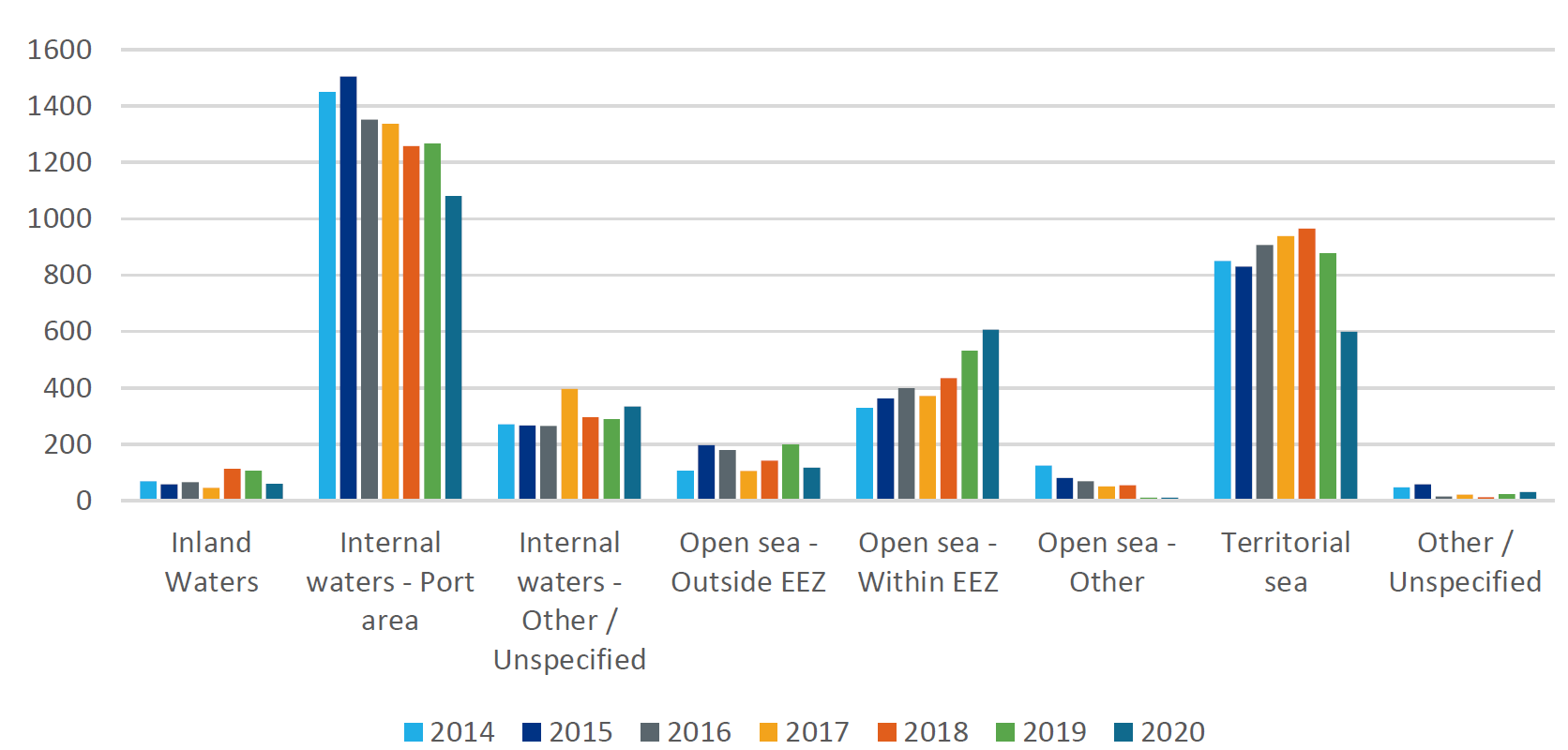
*Marine casualties and incidents which: involve ships flying a flag of one of the EU Member States; occur within EU Member States’ territorial sea or internal waters as defined in UNCLOS; or involve other substantial interests of EU Member States.





In order to understand how JIT can be implemented, it is important to first understand how a ship calls at a port, and all the information that is exchanged between the different actors. JIT requires strong triangular cooperation between the authorities, cargo services and the ship operator, and will also require information and data exchange with other service providers within the port ecosystem (e.g. nautical services, other vessel services etc.).
The process behind how a ship calls at a port is set out in the Port Call Process (see image below), which also lays out the data to be exchanged, at what stage and by whom.
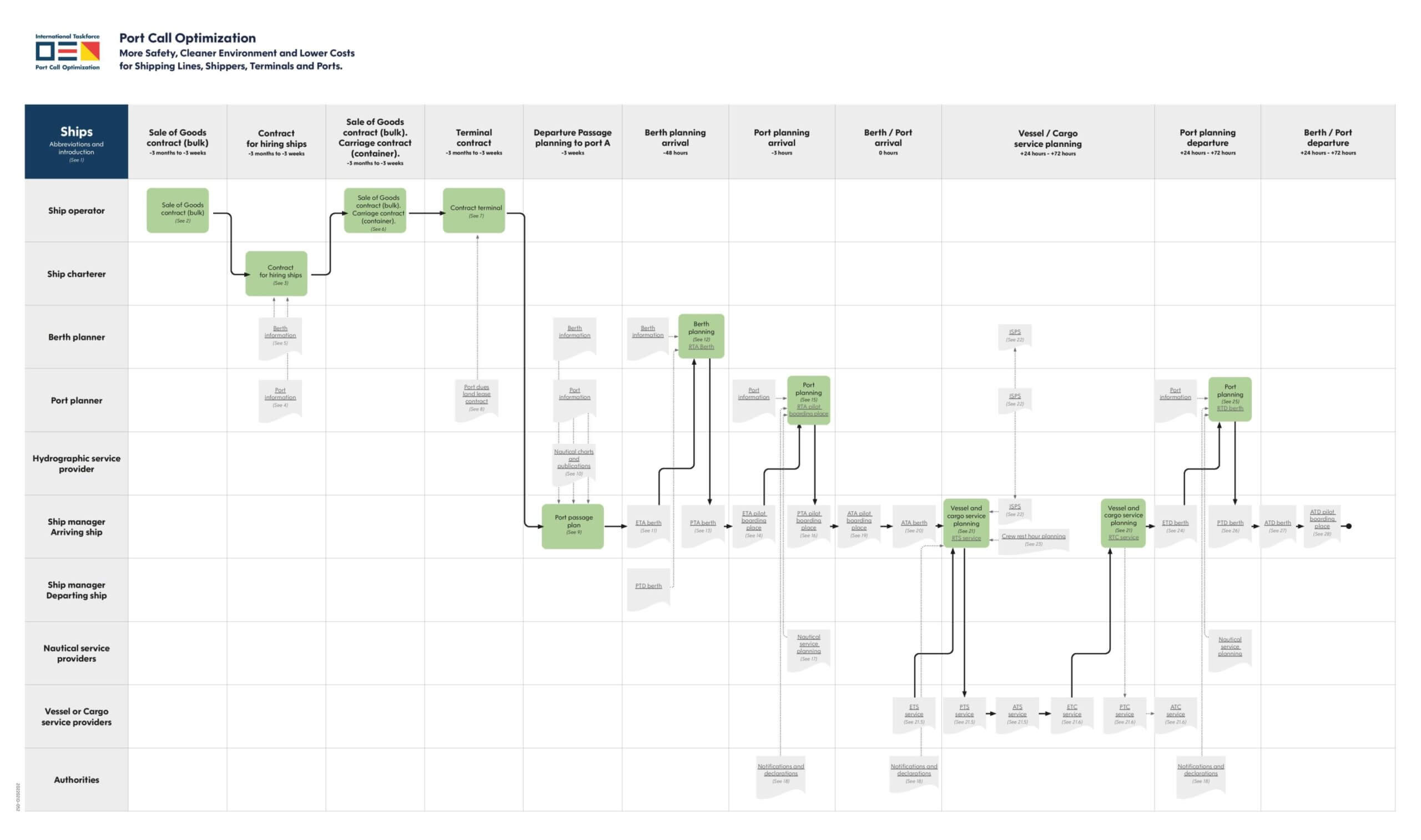
References in the above image refer to the Appendix to the Port Call Process.
While conceptually JIT is simple to understand, in practice it can be challenging to implement. The follow interactive image illustrates the simplified steps that a port can take to implement JIT. Click on each section to find out more. Further details can be found in the JIT Guide.
Before implementing JIT, it is important to understand the motivation and drivers for all stakeholders, or at a minimum, for those who will play a role in the decision-making process. These drivers are likely to be linked to the benefits of JIT (outlined in the previous section).
For example, the Port of Newcastle, Australia, implemented JIT primarily due to safety reasons and to ease port congestion following a major incident in 2007. While safety and easing port congestion may be a key factor for many ports, other motivating factors are likely to be environmental or cost-related. Depending on the different drivers, relevant analysis/studies should be undertaken at a local port level to assess the potential impacts of JIT (e.g. studies on emission reduction potential through use of AIS data or on small-scale per voyage analysis, cost-benefit analysis etc.).
If the drivers and motivating factors for the implementation of JIT are well understood, and are further underpinned by studies/documentation, this will greatly support the securing of buy-in from the stakeholders who are crucial for implementation.
Once a clear motivation to implement JIT has been established and agreed, relevant actors and stakeholders will need to identify the existing barriers and gaps which will need to be addressed. In this section, we have broadly organized such barriers into the various categories:
The following sections provide more information on various potential barriers and some key questions that should be considered for the implementation of JIT.
For some ships, particularly those under voyage charter (i.e. most bulkers and tankers), there may be contractual barriers during the laden voyage owing to the Due Despatch clause which obliges the ship’s master contractually to proceed to the next port with utmost despatch, regardless of whether a berth is available or not.
An additional complication is added when a ship carries several different cargoes. For example, a parcel tanker may carry 20 or more different cargo parcels. Per parcel, multiple parties are involved in the commercial agreements e.g. seller, buyer, broker, charterer and shipowner, and the shipowner may have different obligations to different cargo owners.
These contractual issues can be potential resolved through the inclusion of additional JIT clauses in the charterparty which would allow for virtual arrival and lay out how costs/revenues are to be shared between the shipowner and ship charterer.
One of the most vital enablers of JIT is the exchange of high-quality, accurate and reliable data between key stakeholders within the port, and with the ships – these include times of arrival, times of departure, service completion times as well as many other timestamps. Data exchange plays a critical role in the implementation of JIT and therefore, the digital exchange of data in a uniform way is of immense operational importance. This requires the use of global harmonized data standards.
During a port call, there are various types of data sets which are exchanged:
In order to implement JIT, it is important that the nautical, administrative and operational data sets implemented are aligned with their corresponding standards. Implementation guides for each data set are either currently available or under development and can be found below.
Unsurprisingly, the most important timestamps for JIT are related to the arrival of the ship. As many ships are on berth exchange, the timestamps related to the outgoing ship are important. For more information on these timestamps, please refer to the JIT Guide.

Estimated Time of Completion (ETC) – Cargo. The date and time the berth planner estimates that all cargo operations, related to the ship, will be completed.
Estimated Time of Completion (ETC) – Bunkers. The date and time the bunker barge estimates that the bunker operation will be completed.
Estimated Time of Departure (ETD) – Berth. The date and time the ship or agent estimates to depart from the berth. The ETD Berth is based on the completion time of cargo operations and all other critical services to the ship (for example bunkers, provisions, waste disposal, clearances). Note: Focus is on ETC Cargo and Bunkers as these services are critical and normally cause most delays.
Requested Time of Departure (RTD) – Berth. The date and time the port planner requests the ship to leave the berth. This timestamp is based on the ETD Berth and is a confirmed time for departure based on the availability and planning of nautical services, wind, tide, fairway conditions and planning.
Requested Time of Arrival (RTA) – Berth. The date and time the berth planner requests the ship to arrive at the berth. Note: RTA Berth depends on the RTD Berth of the previous vessel.
Requested Time of Arrival (RTA) – Pilot Boarding Place. The date and time the port planner requests the ship to arrive at the Pilot Boarding Place in order to meet the RTA Berth. This time is closely linked to overall port planning and planning of nautical services. Note: RTA PBP depends on the RTA Berth.
The implementation of JIT requires all parties involved in the arrival and departure of a ship to cooperate, the main actors being:
It is suggested that the key stakeholders in a port in relation to Just in Time should be mapped, translating the Port Call Process to the local situation.
After considering the various questions above and identifying the major barriers and gaps, an action plan should be developed to address them, including timelines, necessary actors, cost implications and scope etc.
While efforts have been made to provide some general solutions in the JIT Guide, since many barriers have local causes and are owing to local circumstances, the solutions will also differ for every port.
As an example, the following steps could be used to solve capacity constraints at a service provider:
How big is the difference between the desired capacity and the delivered capacity over time?
Why does this arise? How is this expected to developed? Which factors are the basis for this?
What costs occur as a result of this gap?
Which solutions are possible and who plays a role in these solutions?
What are the costs/investments required for the proposed solution? How could these costs be settled?
This phase indicates the execution of the developed action plan with a view to implementing JIT.
The timeframe for implementation will depend on various factors, which are detailed in the table below.
| Factor | Shorter implementation time | Longer implementation time |
|---|---|---|
| Main motivation/Driver | Safety – often due to top-down approach from local/regional government. | Environmental/other – due to bottom-up approach of ports/actors pushing for implementation. |
| Size | Small port | Large port |
| Trades | Focus on containers | Focus on bulk |
| Terminal and nautical services set up | Owned by Port authority | Owned by individual private companies |
| Digitalization status | Digital mature port | No digital flows in port yet |
| Service capacity (terminals and nautical services) | Shortage of capacity – there is a need for services to implement JIT. | Over capacity – there is no need for services to implement JIT. |
Ningbo-Zhoushan Port – Submitted by Zheijang Maritime Safety Authority, China
Port of Algeciras – Submitted by Algeciras Port Authority, Spain
Developed by IAPH, IHMA and ITPCO, this document provides guidance on the implementation of Nautical Data standard, predominantly from the IHO.
DOWNLOAD
This document provides an overview of the JIT Arrival concept, barriers and potential solutions to its implementation.
DOWNLOAD
This document presents several low-cost measures which could be implemented in ports to reduce emissions from ships.
DOWNLOAD
This document presents the results of a study exploring the emission reduction potential of the application of JIT Arrival in the global container shipping sector.
DOWNLOAD
This flyer provides relevant information for ports and terminals on the IMO Carbon Intensity Indicator (CII)
DOWNLOADThe Low Carbon GIA, which operates under the framework of GreenVoyage2050, has been working on the concept of JIT for the past several years, developing awareness-raising material, guidance and resources to support implementation, and undertaking studies and calculations to assess the emission reduction potential.
With the upcoming entry into force of major amendments to MARPOL Annex VI, in particular the carbon intensity indicator (CII) requirements, it is expected that more attention will be paid to port call optimization and potentially JIT as ships seek to reduce their port stays and idle time.
If you are a port authority and are keen to offer JIT for ships calling your port, and are looking for further assistance on implementation, please reach out to the GreenVoyage2050 project team to see how we can support you!