

This document has been developed by Green Marine Associates (Edmund Hughes) and the GreenVoyage2050 PCU (Astrid Dispert, Minglee Hoe and Jamie Jones), with inputs from Sukhjit Singh, MTCC-Pacific (Zullah Mohammed) and the IMO Marine Environment Division (Roel Hoenders, Camille Bourgeon and Vianney Houette), based on the GEF-UNDP-IMO GloMEEP Project and IMarEST Ship Emissions Toolkit, 2018 Guides No. 1 and 3.
Download the guide here.
In April 2018 the International Maritime Organization (IMO) adopted resolution MEPC.304(72) on the Initial IMO Strategy on reduction of GHG emissions from ships that identifies levels of ambition including to peak GHG emissions from international shipping as soon as possible and to reduce the total annual GHG emissions by at least 50% by 2050 compared to 2008 whilst pursuing efforts towards phasing them out as soon as possible in this century.[1]
The Initial IMO GHG Strategy identifies as a candidate short-term measure to “encourage the development and update of national action plans to develop policies and strategies to address GHG emissions from international shipping in accordance with guidelines to be developed by the Organization, taking into account the need to avoid regional or unilateral measures”.
In July 2023, IMO Member States adopted the 2023 IMO Strategy on Reduction of GHG Emissions from Ships, with enhanced targets to tackle harmful emissions. The revised IMO GHG Strategy, adopted at the Marine Environment Protection Committee (MEPC 80) includes an enhanced common ambition to reach net-zero GHG emissions from international shipping by or around, i.e. close to 2050, a commitment to ensure an uptake of alternative zero and near-zero GHG fuels by 2030, as well as indicative check-points for international shipping to reach net-zero GHG emissions for 2030 (by at least 20%, striving for 30%) and 2040 (by at least 70%, striving for 80%).
In this regard, IMO resolution MEPC.367(79) adopted in 2022 encourages Member States to develop and submit voluntary National Action Plans (NAP) to address GHG emissions from ships, outlining respective policies and actions. NAPs may be developed by Member States willing to initiate early actions at national level to facilitate the reduction of GHG emissions from ships without awaiting the entry into force of measures in the IMO context. The resolution suggests that the National Action Plans could include but are not limited to:
Resolution MEPC.367(79) invites Member States to submit their NAP to the IMO Secretariat and provide updates, as relevant, thereafter. A repository of submitted NAPs is available on the IMO website.[2]
The development of a NAP could mobilize a broad range of national stakeholders to get involved in ship emissions reduction efforts, including those in shipping-related sectors that may not necessarily be covered by IMO conventions, and thereby bring in new ideas, experience, capabilities and resources.
In their NAP, countries could also encourage and mobilize resources for research, development and deployment of low-emissions technologies and fuels at a national level, or from international financial partners. Through sharing research findings, best practices and lessons learned with the wider maritime community, countries could promote the global uptake of these technologies and fuels. These and other activities could facilitate the step change needed to significantly reduce ship emissions, achieve the IMO’s aims and commitments, and thereby contribute to global air pollution and GHG mitigation efforts.
In addition, a NAP could help countries realize benefits not directly associated with reducing ship emissions, such as:
The NAP development and implementation process also has the potential to strengthen national institutional and technical capacity, and transfer knowledge to sectoral organizations. It can also help countries coordinate among sectors and institutions that currently work in isolation from each other, and allow decision makers to identify synergies among emissions reduction sectoral plans. Furthermore, sending a credible signal regarding future plans to reduce ship emissions can stimulate investment and international support for mitigation activities, promote technological innovation and engage the private sector.
In response to resolution MEPC.367(79) that requests the Secretariat to continue to provide guidance and any further action which may be taken (e.g. through the GloMEEP, GMN and GreenVoyage2050 projects) to assist Member States including developing countries, in particular SIDS and LDCs, for the development of National Action Plans, the GreenVoyage2050 Project has developed a NAP template, which aims to support policy makers wishing to develop a NAP. The process is outlined below.
By their very nature, Small Island Developing States (SIDS) are heavily dependent on transport for access, trade and mobility. Maritime transport, in particular, is the lifeline sustaining the survival of SIDS, given their size, geography, economic structure and high dependence on maritime transport-intensive imports for much of their consumption needs.[3] For that reason, additional guidance and recommendations dedicated to the development of a NAP for SIDS is provided here.
[1] In November 2021, the IMO’s Marine Environment Protection Committee at its 77th session (MEPC 77) agreed to initiate the revision of the Initial IMO Strategy on Reduction of GHG emissions from ships, recognizing the need to strengthen the ambition during the revision process.
[2] https://www.imo.org/en/OurWork/Environment/Pages/RELEVANT-NATIONAL-ACTION-PLANS-AND-STRATEGIES.aspx
[3] UNCTAD (2014) Closing the Distance: Partnerships for sustainable and resilient transport systems in SIDS. https://unctad.org/system/files/official-document/dtltlb2014d2_en.pdf (accessed October 2021)
A key element of developing a NAP is the gathering and analysis of data and information. However, before this work is undertaken it is imperative for policy makers in the country to identify what key policy drivers should be considered when developing a NAP to address GHG emissions from ships.
Additionally, development of a NAP may be both a capacity and resource intensive activity and so the need to develop a NAP should be carefully considered before its initiation. More specifically, it is recommended that the following policy questions should be considered/discussed and answered first in order to determine the need for the development of a NAP:
The following sections provide more detail on each of these questions.
If the answers to these questions indicate a significant/important role for maritime transport, then development of a NAP should be prioritized. If the answers indicate a limited/negligible role, then it is likely that gaining political will to enact policy changes identified by a NAP will be more challenging.
For almost all nations trade, as imports, exports or both, are considered an integral part of their sustainable development goals. Furthermore, maritime transport, due to its efficiency and cost, is considered the most appropriate mode for transporting the goods and commodities being imported or exported. Shipping is therefore likely to be a key contributor and/or a support to most national economies. Its role in this regard, however, can differ and should be reflected in the country’s strategy for legal, policy and institutional changes.
An understanding of the role that maritime transport plays in the national policy context for climate change may be eased by estimating the current contribution of domestic maritime transport related to national emissions of GHG. However, if this is not already identified, then this can be considered as part of the development of the NAP, rather than in the process of identifying the need for a NAP.
It should be noted that according to IPCC guidelines, emissions resulting from the combustion of fuels used for international transport activities should, as far as possible, be excluded from national totals and reported separately based upon location of fuel sales. The encouragement to develop and submit National Action Plans should not be seen as diverging from the current IPCC emissions inventory guidance.
A key part of decarbonization is the energy transition away from a dependence, both nationally and globally, on hydrocarbons to the use of alternative fuels and energy sources. Furthermore, energy transition needs to consider both the source of the energy and also the supply of the energy, including to non-national consumers such as international shipping. For both source and supply, consideration needs to be given to sustainability, reliability and economics.
Once a clear need for a NAP has been identified, steps should be initiated to start development and this is likely to include:
Development of a NAP will require a significant degree of inter ministry/agency and cross-sector coordination. Responsibility for existing shipping legislation and policies are often spread over a range of ministries, agencies and implementing institutions (e.g. Government cabinets, Ministry of Environment, Ministry of Transport, Ministry of Energy, Ministry of Research, Ministry of Education, environment protection agencies, port authorities) and affect a broad range of stakeholders (e.g. shipping companies, industry associations, non-governmental organizations and interest groups).
As a starting point, a public body (e.g. ministry/government department/agency) should be identified to lead this process of NAP development, and other key stakeholders should be identified and engaged. It is recommended that all those who will play a crucial role in the NAP development are involved from the outset, forming a National Task Force (NTF) of manageable size which should be a multi-stakeholder, inter-ministerial group. The task force should include as far as possible all those who will be involved in developing the NAP and abide to an agreed roadmap and timeline.
Whether policy development and implementation responsibilities are shared or separated amongst different bodies, there is an important need for collaboration and communication between the various bodies with agreement made and understood before initiation as to the body coordinating action in order to ensure its legitimacy.
It is recommended that a strong and clear mandate be given to whoever is designated to lead the process of NAP development, from the relevant national authorities at the highest appropriate level.
For these questions it is also important to consider the enactment of international shipping regulations into national laws. Often it is the case that national laws for controlling domestic shipping are covered by policies and laws designed for other industrial sectors. International shipping laws, such as MARPOL Annex VI – the International Regulations for Prevention of Air Pollution from Ships – are usually enacted when a country has significant interests in international shipping as either a large flag Administration or/and has a significant amount of international shipping traffic that enters its jurisdiction and the country wishes to control and enforce internationally agreed rules against internationally trading ships. The enacting of international legislation provides the international trading ship with its ‘ticket to trade’.
For ships entering national ports: ratification and enactment into national law of international regulations allows the country to enforce international provisions against internationally trading ships. A failure to enact international laws leaves the States open to non-compliant international ships entering their waters and ports and not having the powers under international law to challenge and enforce those laws. Furthermore, it weakens the ability of the country to make formal representation to the government of the ship and even informally governments may not be willing to engage more proactively with a country that has not enacted the international requirements.
For the international ship register: increasingly, due to legal and contractual issues, shipowners and operators want their vessels to be registered only with flag States that enact and implement all international regulations. Also ships registered with flag States that have not enacted international requirements are likely to be considered a higher risk by port States and so liable to inspection with the potential for enforcement action to be taken including detention.
A country’s Constitution and administrative governance structure also matter. A centralized government system will require coordination and integration, both within and across ministries and agencies. In a federal system, legal and implementation responsibility may rest partly with the central government and partly with State governments or sub-national jurisdictions.
The establishment of a sound coordinating mechanism is critical to developing and implementing a NAP and needs to be addressed early in the process.
In order to structure the process of developing and implementing the NAP in consultation and cooperation with the relevant agencies and stakeholders, the following actions are recommended:
The process instils ownership and thus ultimately strengthens implementation and compliance. It is also a tool for utilizing the skill sets spread out over a number of institutions, sectors and civil society.
The Lead Body has the principal responsibility for developing the NAP and should be in a position to “champion” the process, i.e. should have a clear understanding of the technicalities of the process and subject matter, along with a strong legitimacy to lead the process.The Lead Body should support mobilizing and securing government buy-in and political will at the highest appropriate level at the earliest stage of developing the NAP and should delegate various aspects or components of the NAP development to other stakeholders with particular competence in the field (e.g. the Port Authority or Ministry of Environment).
It is recommended that a Task Force be established for the purpose of advising and supporting the process of developing and implementing the NAP. The Task Force membership ideally should include both government officials and major national stakeholders, in particular those who would be key to the success of the NAP development and implementation process. It is recommended that the membership of the Task Force include:
The Task Force should be established at the earliest possible stage of the development of the NAP, in order to undertake meaningful consultations and ensure ownership by participants and all relevant stakeholders.
The aim of the NAP should set out where the country wants to be and what the country is aiming for and why. The scope of the NAP should make clear what the plan will address, for example, ship emissions, port emissions, energy efficiency, CO2 or GHG emissions, air pollutants and whether it will be a standalone plan on emissions from shipping or part of a wider national maritime strategy.
It should be noted that resolution MEPC.327(75) specifically mentions the role of Member States in extending the emissions reduction efforts to all shipping-related sectors which are not necessarily covered by IMO conventions.
Defining the aim of the NAP requires an understanding of where the country currently stands in terms of its maritime industry and ship emissions and how these will likely develop in the future. Based on this understanding, the country should identify where it wishes to be, setting out its own vision statement for the future. Defining the aim of the NAP is closely linked with delineating its scope, establishing what aspects the NAP will address and, equally important, what it will not.
The following sub-sections provide more detail on assessing the potential scope of the NAP.
Several issues will need to be considered when identifying the national character of the maritime transport sector for the country. These issues are, in no particular order, as follows:
The following sections aim to support assessment of these components further.
It will be important to identify which ships are of particular relevance to the country and which ships the NAP aims to address. There are various different fleet components which could be considered and further information on the different fleet components can be found below.
The Fourth IMO GHG Study 2020 identified that under a new voyage-based allocation of emissions, some 30 percent of GHG emissions from ships are from domestic shipping, that is ships departing from and arriving in the same country. As such, as part of action to address climate change including efforts under the 2015 Paris Agreement, it is increasingly important that governments consider how they can mitigate emissions from domestic shipping solely under their jurisdiction.
For the fleet of most relevance to your country (i.e. for the fleet to be covered by the NAP):
What are the main ship movement patterns and major routes, particularly in territorial waters, including near ports and harbours?
This is the fleet flying the country’s flag, i.e. vessels that are registered in the country, regardless of whether they are actively trading in the country’s waters or not. This fleet is likely to include vessels whose owners are not citizens or nationals of the country.
The registered fleet will be of high importance to countries with a large ship registry and hence the associated responsibility as a Flag State but also to countries where ship registration constitutes an important income source.
The domestic fleet consists of vessels servicing the country’s domestic transport demand by moving goods and people from one port of the country to another port of the country, both along a country’s coast and on inland waterways. The distinction between domestic and international shipping is determined on the basis of port of departure and port of arrival, and not by the flag or nationality of the ship. By this definition, the same ship may be engaged in both international and domestic voyages. There are overlaps between domestic and international shipping and it may be difficult for governments to divorce policies for domestic shipping from policies for international shipping and many countries expand provisions from international conventions such as SOLAS or MARPOL to their domestic fleet, and sometimes even go beyond or anticipate future IMO requirements, which may incentivize early movers.
Domestic shipping falls under the country’s national jurisdiction and inventory of domestic emissions (IPCC, 2006). It could also, for example, be included in a country’s Nationally Determined Contribution (UNFCCC, n.d.) under the 2015 Paris Agreement on Climate Change.
The domestic fleet is likely to be of high importance to countries with long coastlines or extensive inland waterways, as well as for island countries.
The fleet servicing the country’s international transport demand consists of those vessels moving goods and people between one of the country’s ports and a port of another country.
This fleet might be of particular importance to countries with high volumes of imports and/or exports carried by sea and large or many ports. Although NAP’s influence on this fleet may be limited, countries may wish to explore the potential of port incentive schemes or the supply of low-carbon and zero-carbon fuels for international shipping.
The fleet passing through the country’s territorial waters includes those vessels that enjoy the right of innocent passage through the territorial sea (UNCLOS, article 17), i.e. vessels that operate in the territorial waters, but do not stop at a port of that country.
This fleet might be of particular relevance to countries with long coastlines as well as to countries close or adjacent to international key trading routes, which are generally located between major markets such as North America, Western Europe and East Asia. Along these routes, there are locations at which ships are forced to pass through in order to reduce distance travelled and costs. These points can be regarded as bottlenecks or choke points (the Panama Canal, the Suez Canal, the Strait of Malacca, the Strait of Hormuz, the Strait of Gibraltar and the Strait of Dover). These areas of high ship densities give rise to significant navigation risks and can also result in poor air quality affecting coastal communities.
It should be considered that there may be a limited influence of a NAP on this fleet, especially since, under UNCLOS, Coastal States may adopt laws and regulations for the prevention, reduction and control of pollution from vessels through the “competent international organization” (e.g. IMO).
This is the fleet of ships owned by companies registered in the country. UNCTAD (2014) distinguishes between the concept of the “nationality of ultimate owner” and the “beneficial ownership location”. The latter reflects the location of the primary reference company; that is, the country in which the company that has the main commercial responsibility for the vessel is located. The “nationality of ultimate owner” is the nationality of the ship’s owner, independent of the location of the primary reference country. Just as today most ships fly a flag from a different country than the owner’s nationality, owners are increasingly locating their companies in third countries, adding a possible third dimension to the “nationality” of a ship (UNCTAD, 2014).
This is the national fleet of fishing vessels operating from/to a port of the country. Fishing vessels, although not engaged in maritime transport strictly speaking, share many of the technical challenges faced by other ships in their decarbonization journey.
A number of existing public policies for sustainable fisheries, including targeted State subsidies, may be used to support the decarbonization of fishing vessels, and in this regard may be considered as part of NAPs.
For the fleet(s) identified in the previous section to be covered by the NAP, what is the estimated/calculated ships’ fuel consumption? What is the estimation of emissions from that fleet?
Is the data available of sufficient quality?
Does more data need to be gathered to improve accuracy of emissions estimates?
For future scenarios:
The reduction of emissions from ships, both air pollutants and GHG, is a complex issue that spans different policy areas (e.g. maritime transport, marine environment, climate change, air pollution, energy, transport, trade, infrastructure and human health) and therefore is likely to be covered by different legislation and policies for which different institutions are responsible.
Effective implementation of policies at the national level requires an understanding of the various interlinkages between different ministries and institutions. In reviewing existing regulatory requirements, consideration must be given to the country’s international and regional obligations, national policies and legislation, as well as local regulations, where applicable. A review could also identify existing regulatory gaps or deficiencies in key international agreements and conventions related to air pollution and greenhouse gas emissions which may be of direct or indirect relevance to reducing emissions from ships, such as the United Nations Convention on the Law of the Sea, 1982 (UNCLOS), MARPOL Annex VI and the 2015 Paris Agreement under the United Nations Framework Convention on Climate Change (UNFCCC).
In addition to these international agreements, countries may be engaged in regional or supranational cooperation related to air pollution and climate change. While there are few regional agreements that focus purely on climate change and air pollution, climate-relevant provisions can be found in other regional or supranational agreements that were launched with other objectives, but have potential implications on climate change and air pollution.
The links between climate change and air pollution to various other topics mean that several ministries, government agencies or other institutions can be responsible for, or impacted by, national legislation to reduce air pollution and GHG emissions from ships. Therefore, it is important to identify which maritime sectors and stakeholders are expected to play a role in the reduction of GHG emissions from ships.
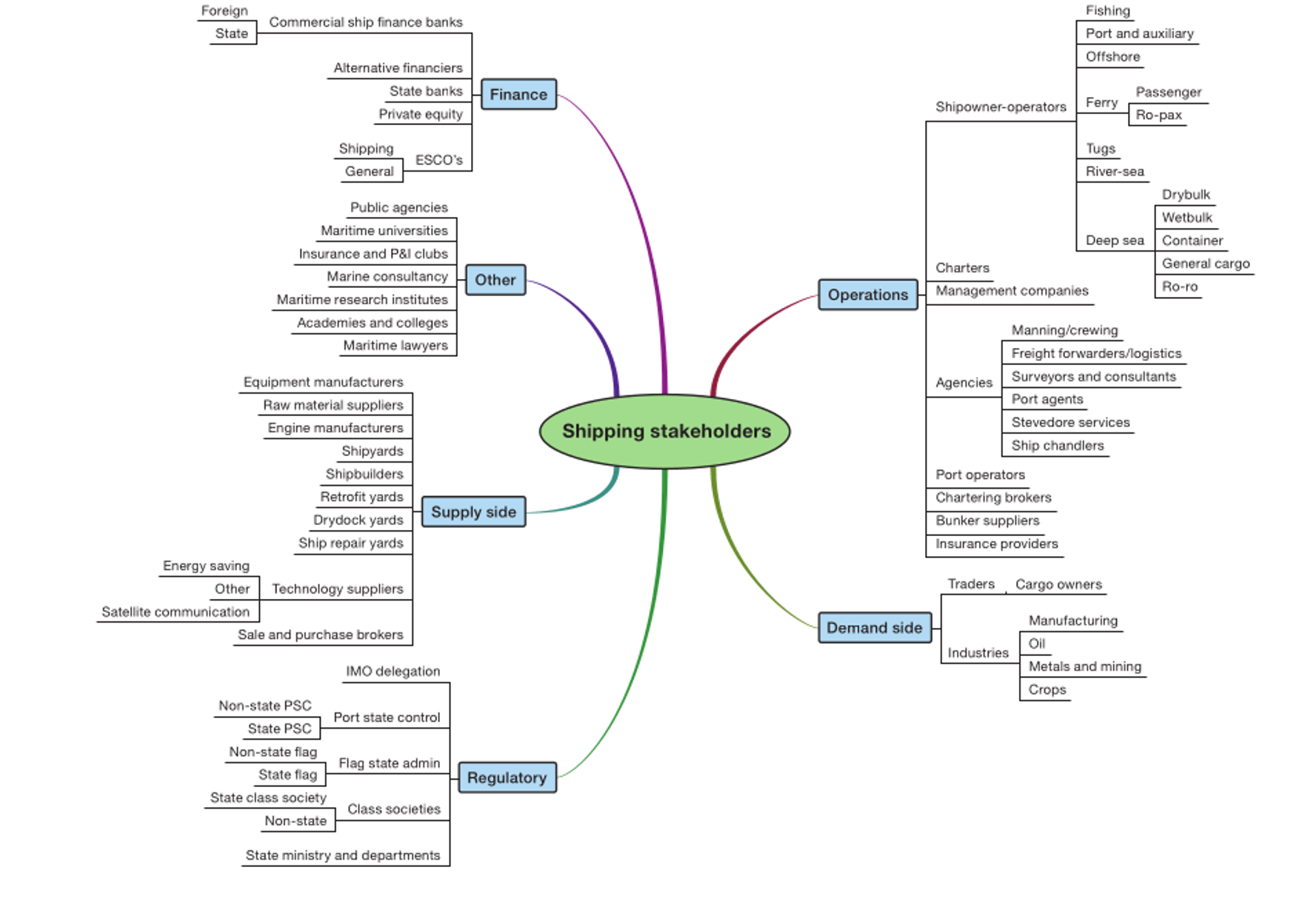
Ports are increasingly an important part of the efforts by maritime transport to decarbonize and need to be considered as part of any NAP to reduce GHG emissions from ships. This has been acknowledged by the IMO in resolution MEPC.323(74) that invites Member States to encourage cooperation between port and shipping sectors to contribute to reducing GHG emissions from ships.
Several issues will need to be considered when identifying what role ports could play as part of the potential for addressing GHG emissions from ships. These issues are, in no particular order, as follows:
It is important to understand the country’s ports in terms of their capacity or throughput by freight types (e.g. for containers and bulk commodities), the type, size and number of ships they handle and any future expansion plans.
Complementary projects should capture upscaling initiatives related to promoting green shipping, pollution prevention, energy management and climate resilience of port infrastructure and operations.
Understanding the role and importance of ports in a country can help determine the scope of the NAP and what actions could be taken to address emissions. As all ports are different, it may be appropriate for individual ports to assess their own emissions and develop emissions reduction strategies accordingly, inline with the targets and goals set out in the NAP. In this regard, the GEF-UNDP-IMO Global Maritime Energy Efficiency Partnerships (GloMEEP) Project has published a Port Emissions Toolkit, to provide guidance to ports in developing a port emissions inventory, and how to develop a port emissions reduction strategy. The toolkit can be found here.
Furthermore, Arup, the engineering consultancy company, has developed a framework for ports to establish an organizational net-zero roadmap.[1] The figure below identifies the stages in developing a roadmap. Importantly they argue that this process helps realize the benefits that system-level consideration of decarbonization trends can bring, whilst also facilitating emissions reductions in ports’ direct control and their zone of influence.
Ports and their hinterland are also critical hubs for services to support shipping including bunkering, repair docks and shipyards, shipping companies, and maritime education and training establishments. All these need consideration as relevant stakeholders and as having a role in the reduction of emissions from the maritime sector.
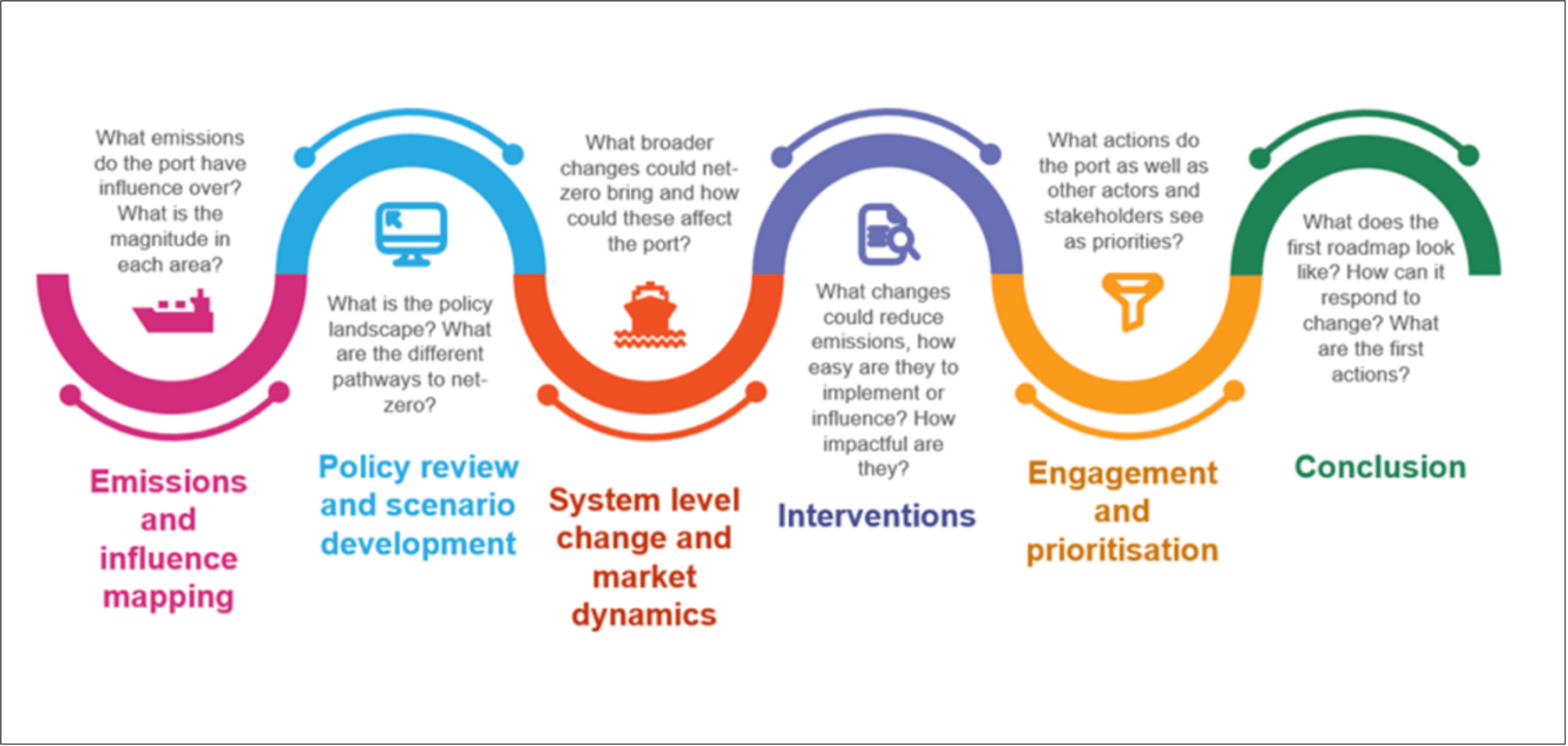
Stages in developing a net-zero roadmap for ports (Arup, 2021)
[1] Arup (2021) Ports: Net-zero, systems thinking and big opportunities. June 2021 https://www.arup.com/perspectives/ports-net-zero-systems-thinking-and-big-opportunities
Once the aim of the NAP has been established in line with other relevant national policies, it needs to be further elaborated through the identification of a set of objectives and actions.
There is no single set-way to develop the national actions to be included in a NAP and there are different approaches which can be considered. For example, a country may decide to break down the national actions by shipping fleet, setting national actions for specific ship-types such as domestic passenger ships, and other national actions for cargo ships. The figure below highlights several approaches based on existing National Action Plans. A repository of NAPs submitted to IMO can be found here.
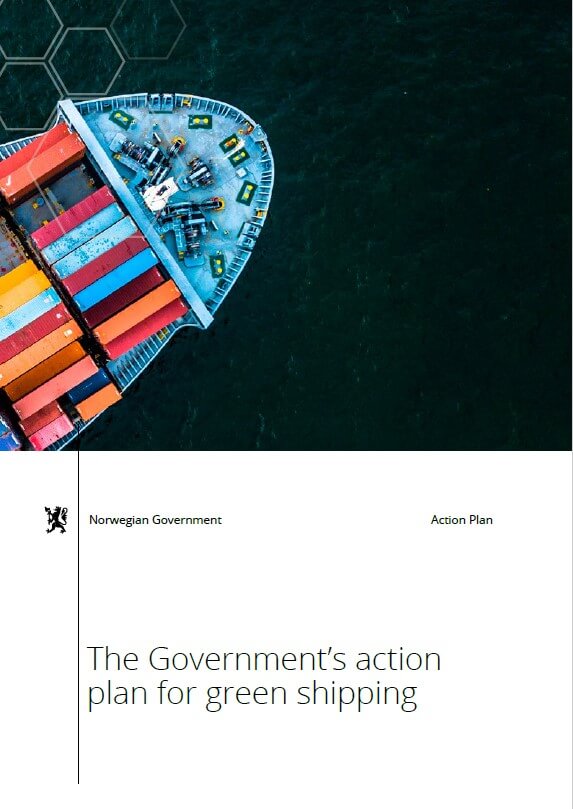
The Norwegian Government’s action plan for green shipping has structured its actions by ship-type, providing the status, measures and instruments for the different ship categories. This approach recognizes the differences in terms of the types of transport for which the ships are used, where they operate and the age of the fleet.
The UK’s Clean Maritime Plan has a strong emphasis on the economic opportunities for low- and zero- carbon shipping and is underpinned by detailed research into how it can capitalize on the potential economic benefits associated with the transition to low carbon shipping.
India’s Maritime Vision 2030 is a wide-ranging plan for the Indian maritime sector, and as part of its approach seeks to benchmark India against the performance of key trading partners and competitors and in doing aims to learn from the best practices of those entities.
Objectives provide a more granular level of detail and define the specific outcomes that are needed to achieve the aim, answering the question “What needs to be achieved to get from where we are now to where we want to be?”
Objectives should be SMART:
With the objectives set, actions should be identified. The completion of actions will deliver the wider ranging objectives. In some cases, an action may only address one objective, while in other cases they will help to achieve multiple objectives.
The table below provides some examples of possible objectives and actions which could be included as part of the NAP.
| Country status | Possible objectives | Examples of actions |
|---|---|---|
Country has not ratified and/or incorporated MARPOL Annex VI into national law |
Ratification and/or incorporation of MARPOL Annex VI into national law |
|
Many nationals work on board ships |
Offer training to seafarers on MARPOL Annex VI regulations and how to implement them on board |
|
Country has large flag registry |
Promote increase in energy efficiency/decrease in ship emissions among the registered fleet |
|
Country has many or busy ports |
Reduce emissions from ships in port |
|
Significant ship traffic within country’s coastal waters |
Reduce emissions in country’s coastal waters |
|
Country has many or large shipbuilders and/or repair yards |
Increase the construction and/or servicing of low emissions ships; increase capability to retrofit technologies to reduce emissions from ships |
|
Country has significant number of crew trained |
Increase awareness on shipping decarbonization from the crew’s perspective |
|
Lack of data |
Implement or expand a system to collect and analyse ship data especially on traffic and fuel consumption |
|
The choice of objectives and actions should be based on national priorities and criteria. Possible criteria include:
It is unlikely that the NAP will be, or indeed could feasibly be, a standalone strategy. In most cases, the NAP will be intrinsically linked with other national policies and strategies, including, for example, those dealing with energy, health, environmental protection, trade, industry and labour. Therefore, consideration should be given to the potential impact of the NAP and its proposed objectives and actions, positive or negative, on the existing national policies and strategies. This could be done through scenario analysis.
As part of determining the need for the NAP, relevant national policies and strategies should have been identified. Integrating and aligning the NAP objectives or actions with other policy and strategic objectives will help avoid duplication as well as identify areas where the NAP can be implemented through an expansion of existing programmes. This will further strengthen the effectiveness of the NAP by ensuring a more efficient use of existing resources, greater operational efficiencies, and therefore greater overall success.
If there are many areas of overlap, it may be worth considering integrating the NAP into a broader non-maritime strategy (e.g. a national strategy on climate change or air quality), rather than developing a standalone NAP.
Once actions have been identified, responsibility for achieving each action should be assigned to a department or organization best positioned to implement the action.
A national timeframe should be determined for the achievement of each objective and action. While at this stage this can only be an estimate which may have to be adjusted, the timelines should be set as carefully as possible and in conjunction with the implementing organization to ensure that the objectives and actions fit within the overall timeframe to achieve the NAP’s aim, and to help estimate how many resources will be required to deliver the objectives and actions.
Increasingly the key barrier to supporting climate action is finance. Countries need to identify sources of finance/capital that will enable them to take the necessary action to both adapt to and mitigate climate change and so support efforts to achieve their nationally determined contribution (NDC) under the 2015 Paris Agreement.
Whilst multinational funding streams for climate action are available and likely to grow, access to those funds requires insight and understanding to be developed and the lead times to identify and obtain such funds can be significant. The levels of funding required are likely to increase with the ambition of the NAP.
Furthermore, there is an imperative for a country to identify the ‘business case’ for taking policy decisions and to demonstrate that the investment will lead to benefits for the country including the identification of opportunities for economic development and growth. It should be noted that the general rule of thumb for public investment is that investment in infrastructure will lead to economic growth whereas investment in consumption does not.
Another potential source of funds would be the private sector. In such circumstances a return on investment is critical and as such an increased emphasis on the national policy both setting out and identifying how the risks to investment can be mitigated.
It is recommended that discussions with key finance stakeholders on the funding requirements and potential sources of funding be initiated early on in the NAP development process and that national government departments, such as the Ministry of Finance or Treasury, be involved in these discussions.
A summary of major capital types, the level of risk vs. return for each capital type, and the key providers of capital type is set out in the figure below. This summary is taken from a recent journal article[1] that has a focus on finance for developing a sustainable ocean economy. However, it is suggested that the capital types and risks are equally relevant for funding national action to address climate change. As such they could be used to guide consideration of policy on financing action for the maritime transport sector.
Maritime transport could be considered as providing potential for economic development, for example, through research and development, manufacturing, employment in shipping and port services. However, this economic development may only be likely at a national level where the NAP for reducing ship emissions is explicitly linked to other policy goals/initiatives, e.g. development of clean/green/renewable energy.
[1] Sumaila, U.R., et al. Financing a sustainable ocean economy. Nature Communications 12, 3259 (2021)
Furthermore, to promote transparency in implementation of the national action plan, enhance stakeholder buy-in and communicate risk, the use of quantifiable goals and metrics is considered an imperative. Such goals can be linked to graphical representations such as risk registers/traffic light schemes to illustrate progress. This is especially important when linking financial budgets to outcomes.
Once the draft NAP is at a reasonably advanced stage, it should be reviewed in terms of whether it is ‘fit for purpose’. This means that it is clear about the aim to be achieved and how to achieve it. To do this effectively, the NAP must support the direction and vision of the government’s overall policy and it must be easily understandable and accessible to the people who will need to work with it and implement it.
Once the NAP has been reviewed by all relevant parties and is considered ‘fit for purpose’, the document will require formal endorsement and approval/adoption at the highest appropriate political and administrative level, in line with national government protocols.
Potential barriers may include:
Once the NAP has been approved at the highest appropriate level, consideration should be given to how the implementation of actions will be managed, monitored and evaluated and how the NAP will be communicated to various audiences.
Once the aim, objectives and actions are identified, responsibilities allocated, timeframes set and resource requirements as well as potential funding sources identified, the various elements of the NAP can be assembled into an implementation plan. The table below provides a possible outline.
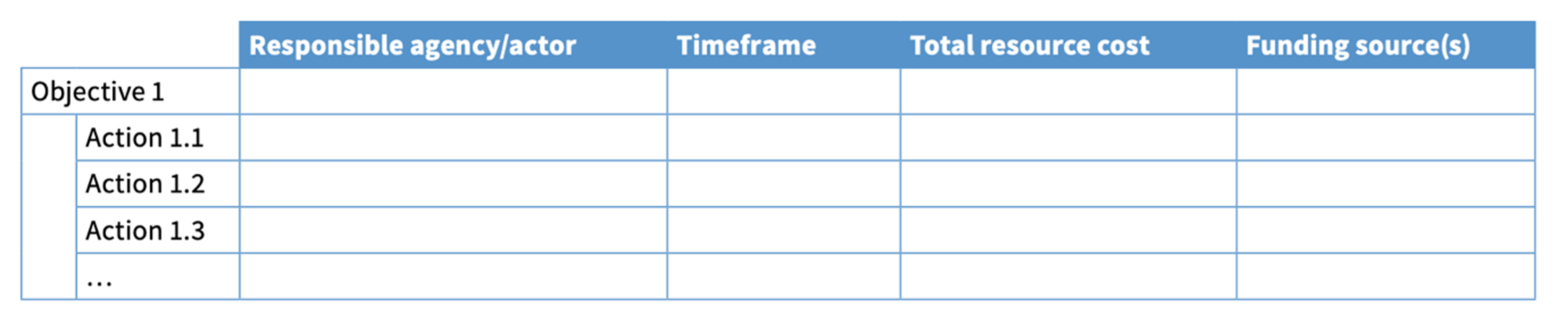
The NAP is expected to cover a significant range of activities which will require careful and consistent management. It is recommended that the management of the NAP implementation be considered at an early stage.
The development and implementation of the NAP is an iterative process rather than a one-off activity and should be monitored, evaluated and revised on a regular basis to ensure the relevance of the NAP in the face of changing national and international circumstances. It is also important to monitor if desired results are being achieved or plan is on course towards the aim of the NAP.
Monitoring
Evaluation
A communications strategy to raise awareness within the maritime community and the general public of the work being undertaken nationally to reduce emissions from ships may be helpful in obtaining wider support for the NAP and should be considered an essential part of the implementation plan.
Once approved, in line with resolution MEPC.327(75), countries are invited to voluntarily submit their NAP, and any relevant updates, to IMO for publication on its website.
Objectives:
Audience:
Messages:
Tools and activities:
Resources and timescales:
Feedback:
By their very nature, Small Island Developing States (SIDS) are heavily dependent on transport for access, trade and mobility. Maritime transport in particular is the lifeline sustaining the survival of SIDS, given their size, geography, economic structure and high dependence on maritime transport-intensive imports for much of their consumption needs.[1]
The specific features that drive SIDS unique economic, social and environmental vulnerability and undermine their transport and trade are grouped into five categories.
The challenges resulting from these features are further amplified by a number of emerging trends, including:
As the challenges are multiple and multifaceted, SIDS national development strategies need to focus on a portfolio of measures that address the transport-related challenges of SIDS while at the same time capitalizing on existing synergies and complementarities involving other sectors such as trade, tourism and fisheries. Relevant response measures should aim to reduce transport costs, improve transport infrastructure and services, build climate preparedness and resilience and promote affordable and low-carbon maritime transport systems that are energy efficient and less fossil fuel dependent. Overcoming these challenges requires that adequate levels of funding be mobilized and that more diversified sources of finance, including innovative financing solutions, be promoted.[2]
UNCTAD has identified that as a consequence of the COVID-19 pandemic SIDS may be subject to longer lasting and more critical impacts.[3] From this perspective, building a stronger maritime sector that can absorb shocks in future and enable SIDS and their economies to recover, thrive and grow requires stronger international and inter-organizational dialogue, cooperation and support, as well as addressing important financial, technological and capacity-related gaps. As such the development of a National Action Plan by SIDS should consider the following key elements.
Promote sustainable domestic and interregional shipping solutions and build resilient trading systems
When disruptions occur, it is important to ensure that the liner shipping connectivity of SIDS is not further undermined. Policy makers can help improve the situation by:
Build capacity to pursue a blue and climate-proof recovery
Enhancing preparedness and risk assessment, mitigation and adaptation capabilities with regard to pandemics and climate change-related impacts and other shocks is key for resilience and recovery.
SIDS are frequently also custodians of large marine ocean spaces. Development in such States is therefore inseparable from the sustainable use and management of marine resources.
Promoting sustainable maritime transport patterns enables diversification towards economic activities that will have less of an impact on ecosystems and reduce the heavy reliance on fossil fuels, while sustaining livelihoods and stimulating job creation. [4]
This entails policies to:
A transition to resilient and sustainable maritime transport in SIDS requires substantial investment.
For example, according to the Pacific Blue Shipping Partnership, the transition to sustainable, resilient and decarbonized maritime transport in States in the Pacific requires at least $500 million.[5] Overcoming the barriers undermining access to finance by SIDS requires:
Specific characteristics of SIDS needing consideration in the NAP
Currently most SIDS rely heavily on imported fossil fuels, mainly oil, for electricity generation and primary energy supply, as well as for transport. Therefore, any plan to transition must include the investments into what types of vessel can access the national ports with the alternative fuel and how that fuel would be stored. Alternatively, consideration could be given to generation/production of energy from local, renewable and sustainable sources such as wind, solar and wave. A second consideration is the energy supply chain to support the energy transition of the maritime transport sector itself.
Noting that many SIDS have a limited influence on international maritime transport policy, maritime transport policy in SIDS is likely to be more focused on specific shipping sectors such as fishing, domestic passenger and, for international trades, cruise passenger ships linked to tourism. For domestic trades the focus is likely to be on small scale shipping operations that are dependent on the operation of outboard motors for propulsion (2 stroke engine), further limiting in the short-term potential changes that can be made to energy used and supplied.
The age of the fleet in SIDS is a major factor. The ageing domestic fleets lead to higher operating and maintenance costs. From an infrastructure investment perspective, the poor connectivity with ageing fleets is an important implication for SIDS. The demand for alternative fuel / technology will be limited given the less frequency of main fleet vessels, unless new vessels are introduced on the routes. The ageing fleet may offer an opportunity in form of new investments and easy feasibility of technological options suitable for small scale shipping. However, the inability to borrow at affordable rates to invest in new shipping and to insure those assets at reasonable prices is what keeps them trapped in this “old ship replaced by old ship” scenario. From a port perspective, given their low cargo volumes, the potential of regional ports (e.g. a transhipment hub from which smaller vessels serve other island nations) could be explored, and this should be informed by regional awareness and located where there is, or potential for, infrastructure to support deep-sea serving vessels.
The effectiveness of public service within the ‘micro-governance’ of SIDS matters. It is essential for building State capacity to respond to immediate citizen needs as well as such wider challenges as climate change and economic growth. SIDS and other small States face a generalized lack of governing capacity from limited human capital and financial resources. Inevitably, technical capabilities are weak as a small number of people means a limited range of talent, and because talented people cannot specialize but are called upon to fulfil many roles and undertake a wide variety of duties. This leads to systemic uncertainty and excessive routine dependence, inhibiting the realization of rational legal management systems. Whilst resources may be stretched, given the cross-sectoral nature of addressing emissions from ships, buy-in from all relevant groups is of great importance. As such in developing the NAP, consideration could be given to the engagement and deployment of specialists from other countries using finance for capacity building or through collaboration with institutions in other States.
[1] UNCTAD (2014) Closing the Distance: Partnerships for sustainable and resilient transport systems in SIDS. https://unctad.org/system/files/official-document/dtltlb2014d2_en.pdf (accessed October 2021)
[2] ibid.
[3] UNCTAD (2021) Small Island Developing States: Maritime transport in the era of a disruptive pandemic – empower States to fend against disruptions to maritime transportation systems, their lifeline to the World. Policy Brief No. 86, May 2021. https://unctad.org/system/files/official-document/presspb2021d3_en.pdf (accessed October 2021)
[4] UNCTAD (2020) Why a sustainable blue recovery is needed. 21 July 2020. https://unctad.org/news/why-sustainable-blue-recovery-needed (accessed October 2021)
[5] Government of Fiji (2020) Decarbonising Domestic Shipping Industry: Pacific Blue Shipping Partnership, Ministry of Commerce, Trade, Tourism and Transport, 10 November 2020. https://www.mcttt.gov.fj/publications-resources/press-release/decarbonising-domestic-shipping-industry-pacific-blue-shipping-partnership/ (accessed October 2021)
Here you will find various video resources produced by GreenVoyage2050 to support understanding of National Action Plan and the requirements for their development.
What is a National Action Plan and why does it matter for shipping? This short film explores how countries are developing National Action Plans to reduce greenhouse gas emissions from ships. From promoting energy efficiency and low-carbon fuels to enhancing port infrastructure and policy frameworks, these plans are critical to driving greener, more sustainable shipping. These plans are developed as part of IMO’s GreenVoyage2050 Programme.
Watch to learn how national strategies are helping chart a course toward decarbonization and climate action at sea.
Sincere appreciation is given to those who agreed to participate (Order of Appearance):
In an effort to support countries to develop a NAP, GreenVoyage2050 interviewed several countries who have already gone through the process of NAP development to share their experience.
Sincere appreciation is given to those who agreed to participate:
The interviews were recorded and edited into the videos below on Drivers, Benefits, Process and Top 3 Tips for developing a National Action Plan to address emissions from ships.
What might be some of the country’s main drivers behind development of a NAP?
What are the main motivating factors?
What has having a NAP meant for the country? What have been the main benefits? Opportunities?
How did the countries organize themselves before undertaking a NAP? How were stakeholders motivated to participate?
What are the top 3 tips for countries who are starting on this process?